
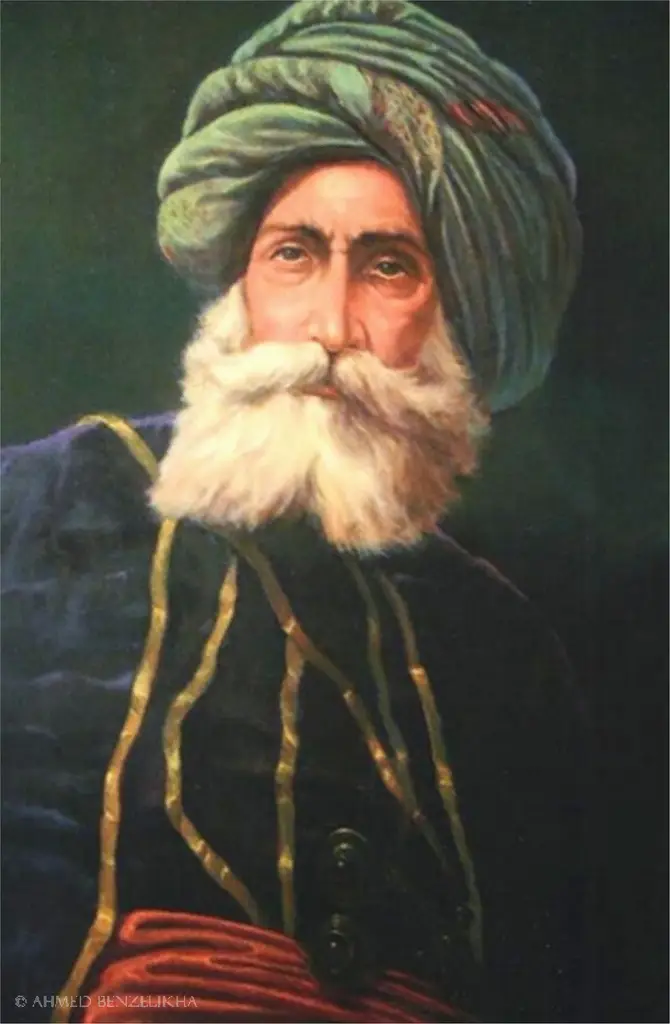
Constantine 1836: from 21 to 24 November, 190 years ago, Ahmed Bey’s city drove back Marshal Clauzel’s French army. Rain, snow, assaults broken at the city gates: it was France’s first major defeat in Algeria, and a chapter of our history that is too rarely told.
What happened in Constantine in November 1836?
The French army tried to take Constantine and failed. After three days before the ramparts, Marshal Clauzel ordered a retreat on 24 November 1836.
In 1836, Constantine was the capital of the Eastern beylik, ruled by Ahmed Bey. Six years after the capture of Algiers, it remained one of the great centres of resistance to the French conquest.
Who defended Constantine against Clauzel?
Ahmed Bey and his khalifa Ali ben Aïssa. Ben Aïssa held the city and its ramparts, while Ahmed Bey harassed the French army from outside with his cavalry.
This double defence, inside and outside, put the French army in difficulty from the moment it arrived. The supply and ammunition convoy at the rear was attacked and largely lost.
How many men did the French army have?
A little over 8,000 men, with field artillery, according to the sources. Setting out from Bône (Annaba) around 8 November, the expedition came within sight of Constantine on 21 November.
The weather was terrible. Rain, snow and hail turned the ground into mud. The soldiers lacked fires and food, and many suffered from frostbite.
Why did the French assaults fail?
Because the city gates held. The attacks on Bab el-Kantara and Bab el-Djedid, notably on the night of 23 to 24 November, were repelled by the defenders.
The French artillery was not ready, and ammunition and supplies were running out. On the morning of 24 November, Clauzel gave the order to retreat.
How heavy were the French army’s losses?
The sources cite 453 killed and 304 wounded in the fighting, and several hundred more deaths during the retreat towards Guelma and then Bône.
The retreat itself was an ordeal. Commander Changarnier’s rearguard had to form a square to hold off the horsemen pursuing it. Wounded and sick men were abandoned along the way, and the army only reached Guelma on 28 November.
In France, the defeat caused a scandal and Clauzel was heavily criticised. In Constantine, the victory was celebrated for three days.
Why does this victory still matter today?
Because it shows that the conquest was anything but a walkover. Six years after 1830, a regular European army failed before an organised Algerian city, defended by its inhabitants and by its bey’s troops.
Geography played its part. Constantine sits on a rock, surrounded by the gorges of the Rhummel, and can only be reached by a few approaches the defenders knew perfectly.
For many of us, Constantine brings to mind its bridges, malouf music and the history of the beys. November 1836 is a reminder that it is also a city of resistance, whose name went into French military manuals as that of a failure.
What happened after 1836?
France came back a year later with a stronger army. Constantine fell on 13 October 1837, after a siege during which General Damrémont was killed.
Ahmed Bey continued the resistance in the Aurès for several years. The victory of 1836 remains the symbol of a city that forced the French army to retreat.
More dates from our history can be found on the site, such as Badji Mokhtar, killed on 19 November 1954 or the Allied landings of 8 November 1942 (in French).
FAQ
Who was Ahmed Bey?
The last bey of Constantine. He ruled the Eastern beylik and led the resistance to the French conquest in eastern Algeria.
Which gates of Constantine were attacked in 1836?
Mainly Bab el-Kantara and Bab el-Djedid, where the French assaults were repelled.
When did Constantine fall?
On 13 October 1837, during the second French expedition.
Who commanded the French army in 1836?
Marshal Bertrand Clauzel, Governor-General of Algeria.
Read also: Badji Mokhtar, 19 November 1954 · 8 November 1942: Operation Torch in Algeria (in French)
Sources
Wikipédia (fr), Siège de Constantine (1836) · Wikipedia, Battle of Constantine · Glorious Algeria, The Ahmad Bey resistance · Wikipédia (fr), Siège de Constantine (1837)